
YESTERDAY’S TOMORROW · DECEMBER 1900 / YEAR 2000
In 1900, a magazine invited experts to imagine the world a century later. They foresaw long-distance calls, photographs traveling across continents, and prepared meals delivered to homes. They also imagined an alphabet without C, X, or Q. How did the future turn out?
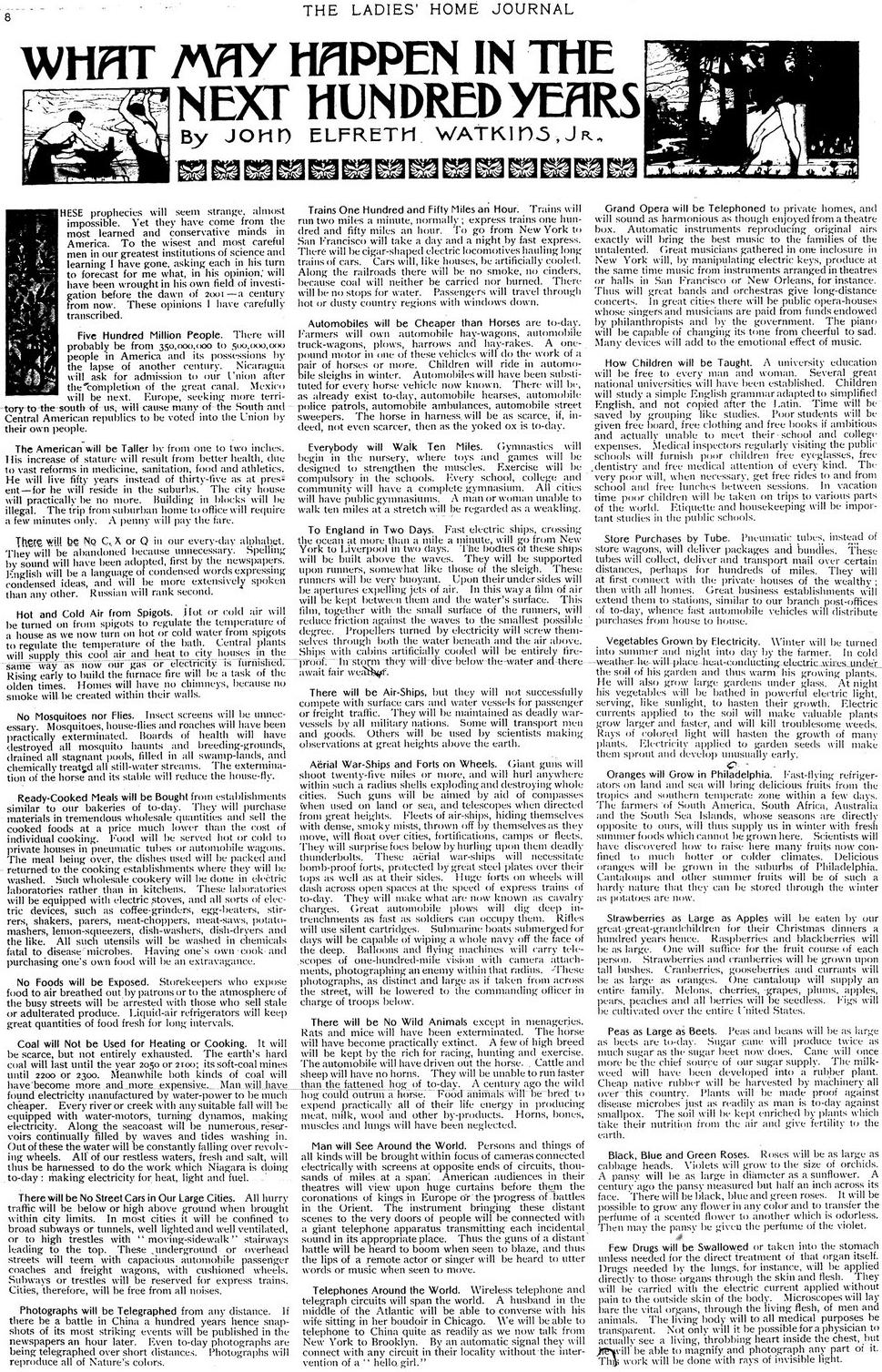

FROM THE ARCHIVE · THE LADIES’ HOME JOURNAL · DECEMBER 1900
What May Happen in the Next Hundred Years
By John Elfreth Watkins, Jr.
Originally published on page 8. Read an archival reproduction or a transcription of the original article.
A century of astonishingly good guesses
Watkins assembled forecasts by consulting specialists, then published his collection at the turn of the twentieth century. The author did not claim supernatural insight: he asked what science and engineering might plausibly achieve by the dawn of the twenty-first century.
Photographs transmitted across great distances. Watkins imagined images of faraway events reaching newspapers remarkably quickly, with color reproduction. He did not describe smartphones or the internet, but the broad prediction—that visual news could travel across the world almost immediately—was strikingly perceptive.
Wireless communication around the globe. The article anticipated long-distance wireless telephone and telegraph communication. The technical architecture turned out differently, but global calling and instant communication became everyday realities.
Ready-cooked meals. Watkins foresaw people purchasing prepared meals and having them delivered home. That broad consumer habit certainly arrived, although the proposed delivery methods included pneumatic tubes and motor vehicles.
Heating and cooling without tending a furnace. He imagined temperatures controlled with the ease of turning a tap. Central heating and air conditioning became familiar comforts, even though his vision of a citywide supply of hot and cold air was not generally how buildings developed.
And then there were the misses
Farewell to C, X, and Q? Watkins expected those letters to disappear from everyday English spelling because other letters could perform their functions. A century later, the alphabet was still intact.
No more mosquitoes or flies. He anticipated that sanitation and pest-control advances would eliminate these insects from ordinary life. That was wishful thinking on a spectacular scale.
Five hundred million Americans? His forecast allowed for roughly 350 million to 500 million people in America and its possessions. The 2000 U.S. Census recorded 281,421,906 residents of the United States. The categories are not identical, but the resident count makes clear that the demographic forecast overshot the nation’s actual size.
The most interesting thing he missed
There is something revealing about what Watkins did and did not anticipate. He could picture the rapid transmission of photographs, distant conversation, and increasingly automated comforts—but not the social world in which those inventions would operate. A person in 1900 might have grasped the promise of instantly exchanging information without imagining the politics of online platforms, digital privacy, or the economics of attention.
That is not a failure of imagination so much as a reminder that inventions are easier to describe than the new habits, conflicts, and institutions they produce.
Yesterday’s tomorrow is our present
The lesson is not that forecasters are fools. Some of Watkins’s broad predictions look remarkably good from 2026; others remain delightfully strange. His successes and failures often came from the same confidence that science and technology would transform ordinary life.
Every generation tries to picture the world its children will inherit. Perhaps the question is less whether the future can be predicted than which parts of our own present we mistake for permanent.
The future arrived. It just didn’t bother to follow all the instructions.
Sources
- The Ladies’ Home Journal, December 1900, page 8 — archival reproduction
- Transcription of Watkins’s original article
- Scientific American, 2008 retrospective
- U.S. Census Bureau, Census 2000
Editorial note: Predictions are paraphrased and grouped by theme. The article distinguishes a broadly realized idea from the specific technical means Watkins envisioned. Its original publication year is 1900; this DejaRevu commentary was published in November 2026.