HISTORY RHYMES · JANUARY 1919 / 2020
A century before Americans argued over face coverings during COVID-19, San Francisco witnessed organized opposition to a mask requirement. The slogans and grievances sound familiar. The circumstances—and the masks themselves—were not the same.
Then: San Francisco, 1918–1919
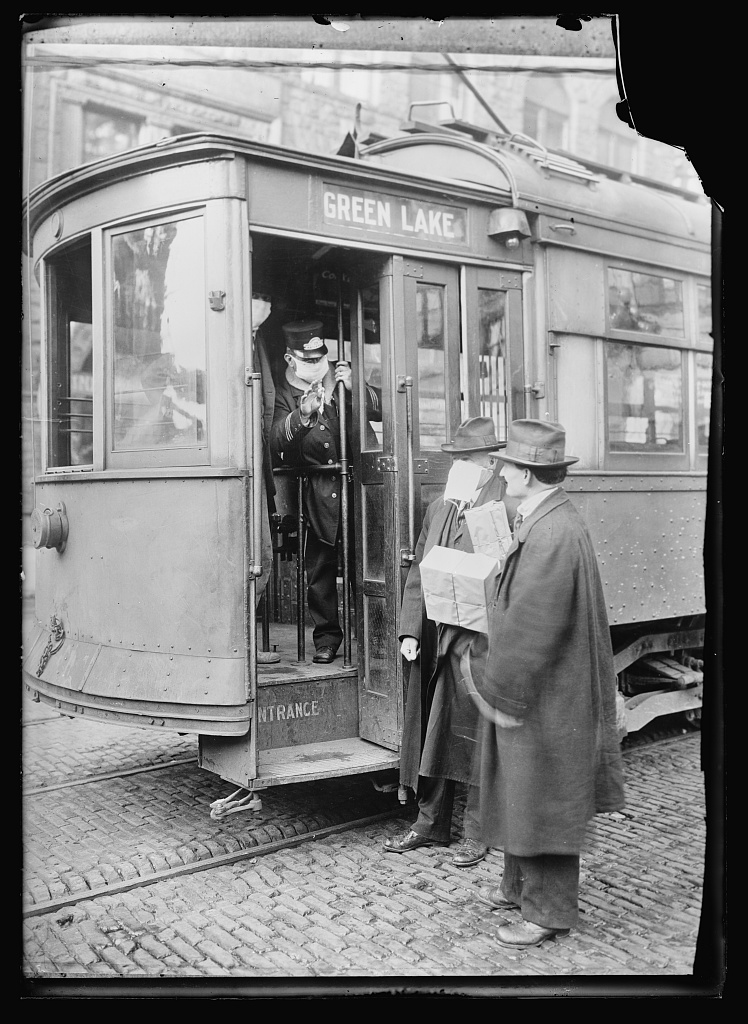
In October 1918, as influenza spread through San Francisco, the city required masks in public. The ordinance was enforced during a world war, when public officials frequently presented compliance as a civic obligation. Many people followed the rule, and volunteers distributed masks. The city lifted its first requirement in November. When influenza returned, officials reinstated masking in January 1919.
This time, some residents pushed back visibly. The Anti-Mask League formed in San Francisco, and a reported crowd of roughly 2,000 assembled to oppose the order. Critics challenged the law’s legitimacy, doubted the usefulness of the masks, and complained about disruption to their lives and businesses. Supporters viewed masking as an obligation to neighbors facing a dangerous outbreak.
Importantly, the contemporary resistance was not representative of the entire country: historians describe scattered pockets of opposition, not a nationwide movement on the scale that later developed during COVID-19. The masks of 1918 were often gauze, unlike many modern respirators, and their effectiveness was debated even among physicians.
Now: The argument returns in 2020
A hundred years later, the COVID-19 pandemic brought face-covering requirements, enforcement disputes, protests and heated debates over individual choice and collective protection. The vocabulary of civil liberties, government authority and personal responsibility returned to public discussion.
The similarities are real, but the context changed considerably. San Francisco’s 1919 episode was local and short-lived; the 2020 debate unfolded across states and countries, amplified by cable television and social media. Public-health technology, scientific understanding, and the political environment were also different.
What rhymes—and what doesn’t
The rhyme: In both periods, an unfamiliar public-health measure became an argument about trust: Who gets to require a precaution, what evidence justifies it, and how much inconvenience should one person accept for the protection of others? The argument outlived the specific ordinance.
The difference: The outbreaks involved different viruses, the protective equipment differed, and the geographic reach of opposition was much greater in 2020. A protest in one city in 1919 is not evidence that Americans everywhere reacted the same way in 1918.
History does not settle the medical question by analogy. It does show that arguments over public responsibility can survive major changes in science, technology and society.
The debate wasn’t invented in 2020. But it wasn’t exactly the same debate, either.
Original sources and further reading
- Politics, Pushback, and Pandemics: Challenges to Public Health Orders in the 1918 Influenza Pandemic
- COVID-19 in Historical Context: Creating a Practical Past
- Virginia Tech historians on masking, 1918 and 2020
- Library of Congress: 1918 influenza newspaper archive
Editorial note: This comparison concerns public debate and the exercise of government authority, not an equivalence between influenza and COVID-19 or between gauze masks and contemporary protective equipment.