
YESTERDAY’S TOMORROW · NEW YORK WORLD’S FAIR / 1939 / THE YEAR 1960
At the 1939 World’s Fair, visitors boarded a moving ride above a miniature America of 1960. The roads were wide, the traffic flowed, and the future looked remarkably orderly. America built the highways. The absence of traffic jams proved harder.
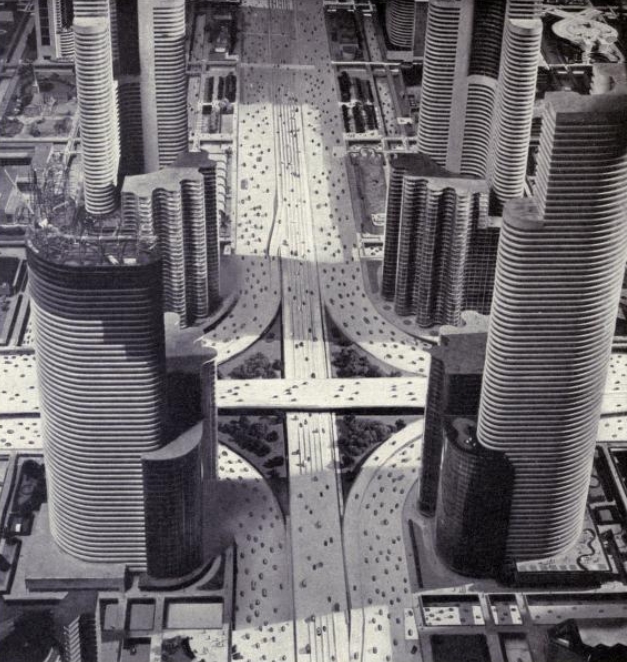
A ride into a world that hadn’t happened yet
General Motors sponsored an extraordinary attraction called Futurama at the 1939 New York World’s Fair. Designed by Norman Bel Geddes, it carried audiences in moving chairs above an enormous miniature landscape, passing cities, farms and a network of imagined superhighways. Visitors watched models of thousands of automobiles moving in a carefully planned future.
A February 9, 1939 newspaper account described roughly 50,000 model automobiles, a layout covering more than 35,000 square feet, and ideas such as automatic road lighting, separated speed lanes and multilevel intersections. The project was a vision of transportation as choreography.
What the exhibit got right
The superhighways. Futurama predicted a national landscape knitted together by wide, fast roads. The United States began its Interstate Highway System in 1956, and the postwar decades saw the massive expansion of expressways, suburbs and automobile commuting.
Road engineering. Grade-separated junctions, controlled access and complex interchanges became familiar. Even the idea that electronic systems might one day manage vehicle movement had a real technical afterlife.
Suburban expansion. The importance of automobiles and suburban development was unmistakable. The future Futurama helped popularize influenced not just what people expected but what public officials worked toward.
What it couldn’t deliver
Traffic without friction. The model’s vehicles moved at designated speeds on orderly lanes. Real cities experienced congestion, crashes, road maintenance, neighborhood disruption and difficult tradeoffs. Building more roads was not the same as eliminating those problems.
Automation on schedule. Futurama imagined coordinated electronic control of vehicles long before the technologies could deliver it at scale. Highway automation remained a research ambition, not a standard driving experience in 1960.
Prediction—or advertisement?
There is another twist: Futurama was not merely a neutral forecast. It was financed by General Motors, a company that stood to benefit from an automobile-centered future. The Smithsonian and Federal Highway Administration both describe how the attraction helped influence public support and policy discussion about highways.
A powerful prediction can help create the conditions that eventually make part of itself true. That distinction belongs in every evaluation of a corporate vision of the future.
Futurama gave its visitors a souvenir pin declaring that they had seen the future. In one respect, they had. In another, they had seen the future its sponsor wanted to build.
They predicted the interstate highway. They forgot to predict everyone else driving on it.
Sources and further reading
- Manassas Journal, February 9, 1939: Creating U.S. of 1960 for Fair Exhibit
- Federal Highway Administration: Don’t Blame the Future
- Federal Highway Administration: Futurama and highway development
- Smithsonian Institution: I Have Seen the Future souvenir button
- Gallup: Futurama and the 1939 World’s Fair
Editorial note: This retrospective distinguishes an achievable infrastructure concept from the fair’s utopian claims about effortless travel. The 1939 exhibit was sponsored by General Motors.