
NOW & THEN · NOVEMBER 2026 / SEPTEMBER 1991
Thirty-five years apart, two failures in America’s communications infrastructure disrupted air travel. The technology changed. The vulnerability looks remarkably familiar.
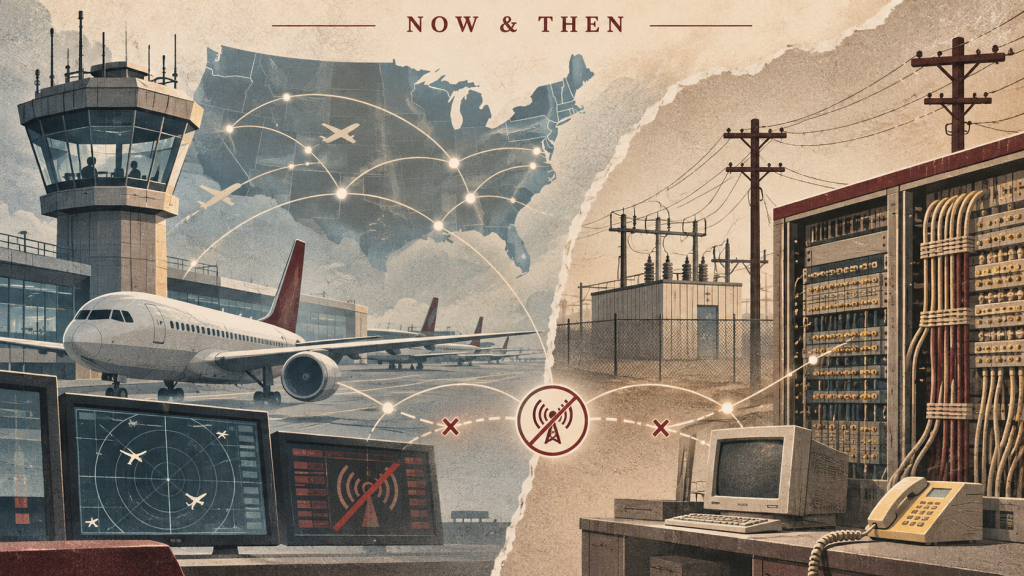
NOW — NOVEMBER 13, 2026
On a Friday afternoon in November, the Federal Aviation Administration ordered a nationwide halt to departing flights.
The problem wasn’t bad weather or a labor dispute. According to the FAA, legacy telecommunications equipment became unstable as data flooded its network, disrupting aircraft communications and radar feeds.
The disruption began around 3:30 p.m. Eastern. Flights resumed at approximately 8:15 p.m., but recovery continued afterward as airlines struggled with displaced aircraft and crews. The agency later reported approximately 12,462 cancellations that day, while cautioning that not all were directly caused by the ground stop.
In a November 15 explanation, the FAA identified a radar facility in Amarillo, Texas, and a radio communications site in El Dorado, Arkansas, as possible sources of excess network traffic. Its contractor had been replacing a router at the latter location. The agency disabled a problematic broadcasting function on new routers as a precaution. Officials distinguished this routine equipment work from the FAA’s broader modernization program.
The episode raised an uncomfortable question: How could instability in the infrastructure supporting air traffic control bring departures across the country to a halt?
THEN — SEPTEMBER 17, 1991
Thirty-five years earlier, an electrical problem at an AT&T switching facility in lower Manhattan produced a remarkably familiar result.
That September afternoon, a power failure disrupted voice and data communications used by air traffic controllers in New York, Boston and Washington. Kennedy, LaGuardia and Newark airports faced severe restrictions. Flights were grounded, delayed or diverted, and disruptions spread across the country.
The following day, the Los Angeles Times reported that a power failure had paralyzed three major New York-area airports. The underlying breakdown was surprisingly mundane.
According to a later U.S. General Accounting Office investigation, AT&T had switched from commercial power to its own supply during a period of heavy electrical demand. Batteries initially supported the switching center, but alarms intended to alert technicians to start a diesel generator had been disabled. When the batteries ran down, critical telephone transmission systems failed.
The GAO documented 1,174 flights canceled or delayed and approximately 85,000 passengers affected. Flight schedules were still disrupted the following morning because aircraft were stranded at the wrong airports.
What began as a problem in one telecommunications building had become a national transportation problem.
THE DÉJÀ REVU
The technical causes were different.
In 1991, the breakdown involved electrical power and failed backup procedures. In 2026, the FAA described network instability and excessive data traffic affecting legacy equipment.
But both episodes exposed the same structural weakness: an enormous transportation network depended on communications systems whose failures could spread far beyond their immediate location.
And both raised questions about redundancy, maintenance and accountability.
In 1991, investigators examined the consequences of telephone-network failures for aviation and other essential services. In 2026, federal officials again confronted the fragility of critical communications infrastructure.
Thirty-five years of technological progress have made aviation communications faster, more sophisticated and more interconnected. They have not eliminated the risks created by infrastructure dependencies.
Perhaps the most revealing parallel is not that the systems failed. It is that in both cases, the disruption demonstrated just how much depends on systems most travelers never see.
EDITOR’S NOTE — NOVEMBER 16, 2026
DejaRevu is also examining whether broader debates over the structure and oversight of U.S. air traffic control have any bearing on this disruption. Project 2025’s Mandate for Leadership (Chapter 19, pages 632–634) proposes separating the Air Traffic Organization from the FAA, changing its funding model and altering its relationship with private contractors. These are policy proposals, not evidence of what caused the November 13 ground stop. No causal connection has been established. We will follow the FAA’s investigation and any relevant policy or contracting developments, and update this article if verifiable evidence warrants it.
THE FINE LINE
Technology advances. Dependence advances with it.
And sometimes the difference between keeping a nation moving and bringing it to a halt is something as ordinary as a router—or a backup battery.
ORIGINAL SOURCES
NOW — 2026
Federal Aviation Administration, “Nationwide Ground Stop: Questions and Answers,” November 15, 2026
Associated Press, coverage of the FAA nationwide ground stop, November 13, 2026
THEN — 1991
Los Angeles Times, “Power Failure Paralyzes 3 N.Y. Airports,” September 18, 1991
United Press International, “AT&T Pinpoints Source of Power Outage,” September 18, 1991