
YESTERDAY’S TOMORROW · AUGUST 16, 1964 / THE YEAR 2014
Science-fiction writer Isaac Asimov looked fifty years ahead from the 1964 World’s Fair. He imagined video conversations, robotic helpers, elaborate automated kitchens—and technology powered by tiny nuclear batteries. His forecast reveals how easy it is to picture gadgets and how hard it is to predict the society built around them.
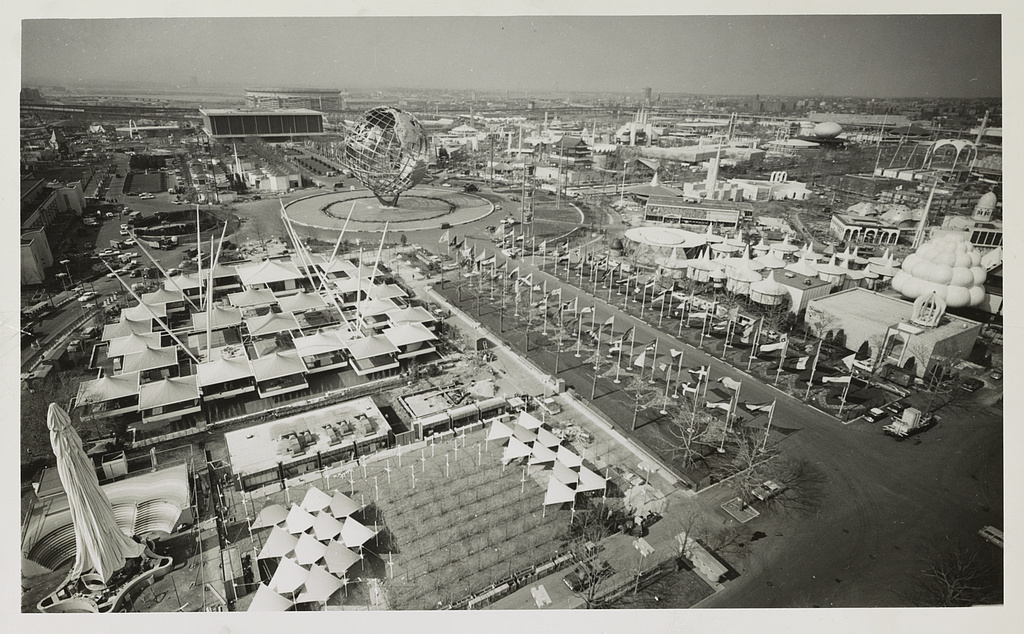
A postcard from the World’s Fair
In an essay published in The New York Times on August 16, 1964, Asimov asked what a World’s Fair in 2014 would look like. His answer began with an optimistic premise: that humanity would survive the nuclear dangers of his own era and keep advancing technology.
He was fascinated by displays of machines that promised to make daily life easier. As a science-fiction writer and a biochemist, he was comfortable imagining plausible extensions of technologies already visible in 1964.
The remarkably good calls
Video conversations. Asimov expected people to see one another while talking at a distance and to use screens for examining documents and photographs. By 2014, video calling and digital displays had become everyday realities, even if he did not anticipate the dominant role of smartphones.
Robots and automation. He expected machines to perform more repetitive tasks and predicted that robots would exist but would not yet be particularly capable or ubiquitous. Household robots and industrial automation existed by 2014, though his imagined domestic help was far beyond what most families had.
Flat displays and advanced lighting. He anticipated glowing panels and large wall-mounted screens. These were recognizably related to technologies that arrived, although his more exotic three-dimensional television cubes did not become common household fixtures.
And the forecasts that missed
Nuclear-powered household gadgets. Asimov envisioned many appliances running without electrical cords, powered by long-lived radioisotope batteries. Cordless devices did become ordinary, but conventional rechargeable batteries—not little nuclear power sources—provided the practical answer.
Underwater settlements. His ideas about extensive colonization of continental shelves and deep-sea cities remained far from ordinary life in 2014. Underwater research habitats existed, but no mass settlement followed.
Life dominated by leisure and boredom. Asimov worried that automation could leave human beings struggling to find purpose. Technology altered work enormously, but a society broadly freed from employment was not the reality of 2014.
What he could not see from 1964
Asimov’s vision was rich in physical objects: screens, automated kitchens, self-guided vehicles, buildings designed for comfort. What the essay did not truly foresee was the web of online relationships, publishing, commerce, social networks and information systems that would reshape everyday behavior.
In other words, he was often better at predicting what a machine might do than how millions of people might use connected machines together. The same distinction is worth remembering whenever we read forecasts about artificial intelligence or any other emerging technology.
Predicting the gadget is one thing. Predicting the world it creates is another.
Original sources and further reading
- Isaac Asimov, Visit to the World’s Fair of 2014, The New York Times, August 16, 1964 (archived copy)
- Smithsonian Magazine, assessment of Asimov’s predictions
- Scientific American, Asimov’s Predictions from 1964: A Brief Report Card
- The New Yorker, contemporary September 1964 response to Asimov’s essay
Editorial note: Asimov’s forecasts were made in 1964 for 2014. This retrospective does not treat a partial resemblance as a precise prediction.