
ON THIS DAY · NOVEMBER 16 · 1938 / 1946 / 1973
On one calendar date, decades apart, a chemist synthesized LSD, a psychedelic thinker was born, and a philosopher of consciousness died. The coincidence is real. So is the question connecting their work.
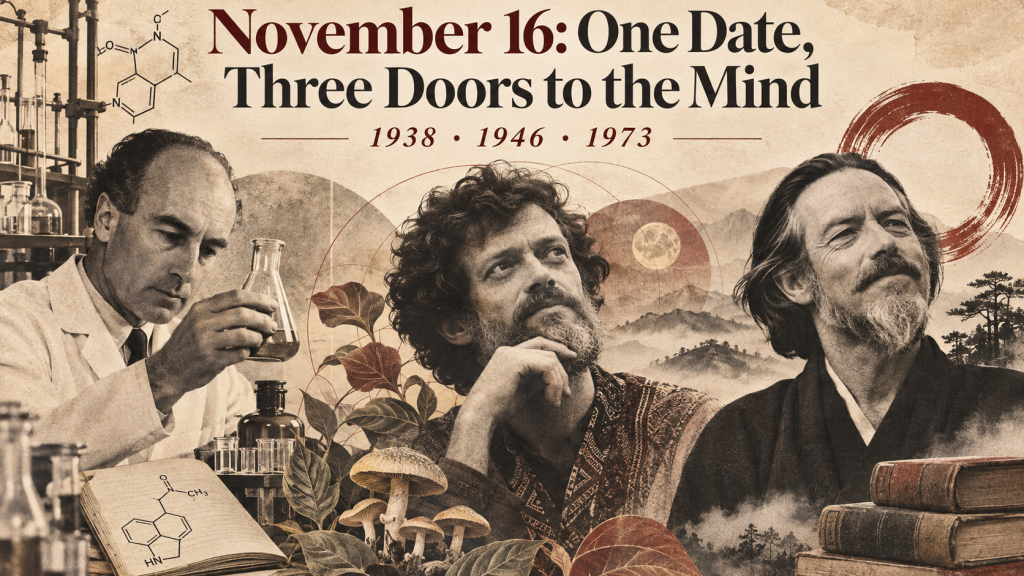
Some dates acquire significance because of a single extraordinary event. November 16 has three: the first synthesis of a substance that would change discussions of perception; the birth of a thinker who would become identified with psychedelic exploration; and the death of a philosopher who had introduced generations of Western readers to Asian philosophical traditions.
Their shared date does not establish a hidden connection. But their careers illuminate three approaches to the same enduring question: what is consciousness, and how much of our experience of reality do we truly understand?
1938 — The chemist opens a door
Albert Hofmann was not searching for enlightenment. At Sandoz Laboratories in Basel, Switzerland, he was investigating pharmaceutical compounds derived from ergot, a fungus associated with grain. The research aimed to find medically useful effects, including possible applications to circulation and respiration.
On November 16, 1938, Hofmann synthesized the twenty-fifth compound in a series of lysergic acid derivatives: lysergic acid diethylamide, or LSD-25. Initial animal tests did not produce enough promising results to keep the research moving, and the compound was set aside.
Only in April 1943, when Hofmann returned to the substance, did its extraordinary psychoactive effects become apparent. His discoveries later fed both scientific investigations and public debates over therapeutic potential, personal experience, regulation and harm. The story started as laboratory chemistry, not a deliberate search for altered consciousness.
1946 — The explorer arrives
Eight years later, on November 16, 1946, Terence McKenna was born in Paonia, Colorado. His later interests ranged across ethnobotany, language, mythology and psychedelic experience.
Where Hofmann approached questions of consciousness through chemistry, McKenna approached them through plants, culture and often speculative interpretations of human experience. His lectures and writing reached listeners well beyond conventional academic audiences.
McKenna proposed ideas about mind and human history that were provocative, but not all were established by scientific evidence. That distinction matters: an intriguing interpretation can invite inquiry without becoming a demonstrated fact.
His recurring question, however, was compelling. Might ordinary waking consciousness be only one of the ways the human brain can experience the world?
1973 — The philosopher departs
On November 16, 1973, Alan Watts died at the age of 58 on Mount Tamalpais in California. A writer and speaker, Watts helped introduce Western audiences to perspectives drawn from Zen Buddhism, Taoism, Hindu philosophy and comparative religion.
Watts also explored psychedelic experience, but his thinking was never confined to it. His larger subject was the relationship between the individual self, everyday awareness and the world we believe ourselves to inhabit.
For Watts, an unusual state of awareness was not necessarily an end in itself. What mattered was how insight might inform ordinary life. His approach could begin with a philosophical question rather than a laboratory compound or a psychoactive plant.
Three approaches, one enduring question
Hofmann gave researchers a chemical substance whose effects transformed discussions of altered consciousness. McKenna explored the cultural, botanical and speculative possibilities of such experiences. Watts examined the assumptions through which people understand the self and its relationship to the wider world.
Their methods differed, and so did their conclusions. It would be misleading to turn them into three voices expressing one agreed theory, or to treat their shared date as anything other than coincidence.
Yet November 16 offers a striking way to revisit a twentieth-century intellectual crossroads: laboratory science, psychedelic culture and philosophy all asking what consciousness reveals—and what it may conceal.
Decades later, that question remains open to scientific research, philosophical disagreement and careful interpretation. The coincidence gets us to the door. The evidence must still guide us through it.
THE FINE LINE
That fine line between discovering a new reality and discovering a new way to perceive the old one.
SOURCES & FURTHER READING
Scientific American, excerpt on Albert Hofmann and the November 16, 1938 synthesis
Purdue University Archives, Albert Hofmann correspondence and biographical materials
Albert Hofmann interviewed by Michael Horowitz (historical first-person account)
Purdue University Archives, Terence McKenna biographical record
Purdue University Archives, Dennis and Terence McKenna papers